Posts

Groundbreaking Research in Org Transformation

Image
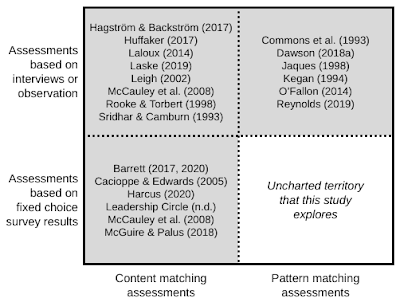
"Extraordinary . . . full of creativity and re-thinking" William R. Torbert 50-year researcher and consultant in vertical OD, author of Action Inquiry, Leadership Professor Emeritus Boston College This doctoral research is about a new way to measure transformation of organizational culture based on a type of complexity called vertical complexity. I evaluated all the ways it had been measured over the past 50 years, invented a new method to assess organizations, and tested my assessment with a formal validation study. This approach integrated the wisdom two related disciplines--vertical adult development and organizational development--in a field I call vertical OD. Largest vertical OD study to date - 500,000-person organization, n=2,536 Most comprehensive review of vertical OD assessments conducted so far New typology to organize vertical OD assessments by their relative strengths & weaknesses New definition of vertical OD - based on vertical complexity New model of verti...
Assessing the Vertical Development of Organizations (Full Dissertation)

Image
Abstract: Organizational development (OD) is increasingly being applied well beyond organizations to solve more complex, global-scale problems. But it is at a disadvantage, since mainstream OD has rejected a type of complexity these challenges contain called vertical complexity. Vertically complex problems, especially intractable ones, tend to remain unsolved by scaling existing solutions. They require new, transformative approaches that depart qualitatively from what has worked elsewhere. The adult development (AD) field specializes in helping people solve more vertically complex problems, but not how to solve them together to tackle challenges at scale. The field of vertical OD integrates AD and OD sensibilities to address complex, global-scale problems, but it is hamstrung by a major measurement problem. Despite 50 years of theorizing, there is still no suitable method to assess the vertical development of a team, organization, or collective of any size. This dissertation was an at...

A Pilot Study to Assess Vertical OD Using Dynamic Systems Theory

Image
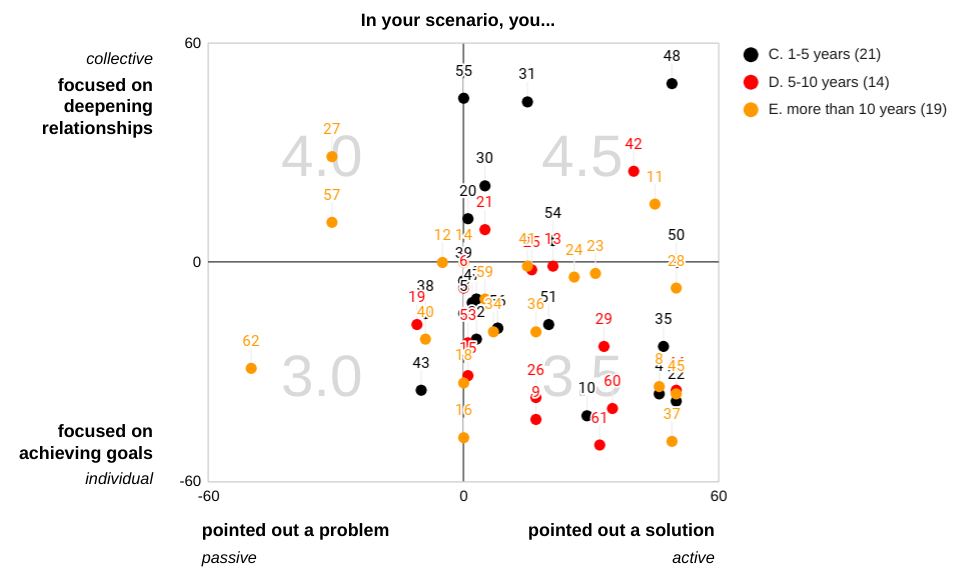
Abstract: This paper summarizes the results of a pilot study that is part of a larger dissertation project to explore the research question  how might an organization assess its own stage of vertical development reliably and efficiently?  The project is an experimental attempt to assess the vertical development of organizations using a new kind of survey to achieve the dual goals of scalability and reliability. A separate  dissertation overview  summarizes the research problem and methodological design that this pilot uses. The pilot was conducted in two phases. The objective of phase 1 was to enhance survey clarity through live user testing with participants. It was very successful and generated many enhancements to the survey’s instructions. The objective of phase 2 was to conduct the first empirical test of the assumptions that underpin this experimental approach. This objective was also achieved and generated substantial enhancements to this new method for assess...

To Change Culture, Start with Beliefs or Behaviors? A Multidisciplinary Answer

Image
Abstract: Do organizations think themselves into a new way of acting, or act themselves into a new way of thinking? Conflicting opinions in the literature have made it difficult for leaders and organizational change consultants to know whether to start by changing beliefs or behaviors. A multidisciplinary review of 100 references on belief, behavior, and organizational change (table 1) was conducted in an attempt to discover commonalities and reconcile differences on this longstanding dilemma. Confusion can be attributed to imprecise terminology and incomplete modeling. To help narrow the scope of this issue, emphasis is placed on the type of organizational change that involves culture change. More precise terms are proposed along with a new schematic of the “organizational braking system” to help leaders and change agents understand the counterintuitive ways they can accelerate culture change. Read this paper

Circling the Hologram: The Four Territories of Awareness

Image
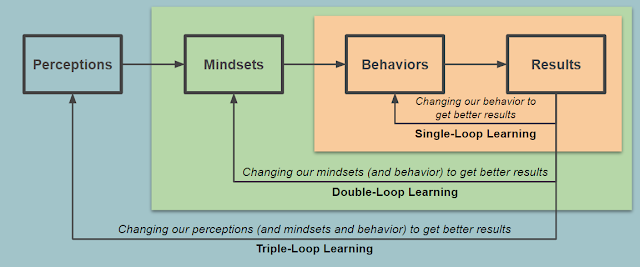
This diagram is so pregnant with so many beautiful principles that it has tightly held my attention since I first saw it.  To unpack this diagram most easily, we’ll start with what’s most familiar to most people, depicted in orange.  The ”Behaviors” box represents our actions--the things we do in life. But any doing we do that's uninformed by the results of our doing equates to the well-known insanity of doing the same thing over and over while expecting a different result. Which is to say that nearly everyone understands the first type of learning shown here--known as single-loop learning.  But that doesn’t mean it’s a given.  The person who knows their marriage is struggling (a result) may not fully know how their behavior has contributed.  An expansion of awareness is needed--one that includes both results and behaviors.  And when this expansion of awareness leads to new behaviors, single-loop learning has occurred. Keep reading

Kegan and Commons: A Comparison

This paper is a comparison of two human development theories, Kegan’s Subject-Object Theory (SOT) and Commons’s Model of Hierarchical Complexity (MHC).  Despite representing two of the most divergent approaches to the discipline, their work is found to contain many similarities including a complexity-based scale, corresponding stages, high generalizability, and a common intellectual forefather.  This exploration of their similarities and differences is organized into three parts: the assumptions, the models, and the process of human development.  A reflection follows as to why one has had a vastly greater impact on the human development field than the other. Read this paper

Why Practitioners Don’t Use Science

Abstract: In this paper, the gap between science and practice is explored through the lens of the social psychology’s theory of planned behavior.  Twenty three articles were analyzed across a variety of disciplines.  A paradigmatic analysis was conducted to categorize the primary perspectives and approaches taken on the science-practice gap.  Then, after a review of the theory of planned behavior, a second analysis was conducted.  Barriers mentioned in the literature were overlaid on the theory of planned behavior as a means to better understand the gap and unlock more effective approaches for closing it. Read this paper